first, the interface becomes a working surface.
dashboards, portals, landing pages, and browser tools built for clarity and speed.
work, experience and skills
This portfolio strives to comprehensively present my personality and work, but primarily focuses on professional activities in the field of software engineering and information technology.
The need for creation, curiosity, the need to understand the world around me, and a thirst for new knowledge—which from the earliest years found their most fertile ground in software, and informatics and computing in general.
At twelve years old began my daily journey through code and computer systems—from microprocessor architecture to the sophisticated levels of abstraction that characterize application software today.
After more than a decade of practical engagement with computers, and almost a decade of writing software, today I can present my technical knowledge as the result of years of consistent dedication to every aspect of software development—from basic logic and understanding hardware limitations to complex architectures of distributed systems.
What emerges is less a collection of skills than a way of working. The same attention that goes into debugging a production incident goes into shaping a reusable abstraction, or refactoring an old module to match a cleaner mental model. The job is never merely to ship—it is to leave behind code that the next engineer will want to read, and systems that continue to explain themselves long after the original author has moved on.
"I see myself as homo poeticus who seeks creative synthesis through all aspects of work.
All of this converges, or rather: all of this is the convergence. The code I write carries the same aesthetic demand as the sentence I construct. The architecture of a distributed system mirrors the architecture of an argument. There is no separation between technical and humanistic—that distinction belongs to an era of specialization I refuse to inherit.
The literary tradition that shaped my thinking runs through the French moralists and Russian maximalists in equal measure—André Gide's acte gratuit and the liberation of authentic action, Proust's obsessive archaeology of memory and time, Dostoevsky's unflinching descent into the cellars of human psychology where logic dissolves into paradox.
Philosophy functions here not as academic credential but as operational framework. Kierkegaard's leap remains the founding gesture—the recognition that at some point analysis must yield to commitment, that infinite reflection is paralysis dressed in sophistication.
Philosophy gives you the questions. Engineering demands the answers. Between the thinking and the building lives the work that matters — late nights, broken deploys, elegant solutions, and the slow accumulation of craft.
first, the interface becomes a working surface.
dashboards, portals, landing pages, and browser tools built for clarity and speed.
then the same logic learns the device.
native-feeling mobile apps with clean flows, responsive screens, and polished interaction.
beneath the screen, the system gets its spine.
APIs, databases, auth, business logic, integrations, and infrastructure behind real products.
connections lock in; the product can ship and keep working.
services, automation, releases, fixes, and maintenance that keeps products alive after launch.
now the build becomes a path.
rough ideas become features, user journeys, MVP scope, and launch-ready decisions.
clarity turns into layout, rhythm, type, and interaction.
interfaces, flows, brand visuals, graphics, and design systems shaped into polished experiences.
the final layer is atmosphere.
visual mood, typography, imagery, motion, and brand presence with a clear point of view.
I started BLink with Petar Kremenović because the city we live in still needed building — a digitized public-transit system, a civic platform that closes the loop, ride-hailing tuned to a local market. A smart-city stack, plus founder tools nobody else was building. So we started a startup.
06 — startup
Petar Kremenović and I founded blink in Banja Luka in 2024 — one startup building five products, each already live with its own users, all shipped by the same small team.
banja luka · since 2024
civic infrastructure · live · Banja Luka · 2024
Citizen reports once vanished into phone calls and paper forms. Urbano puts every one on a single map — geocoded, routed, and tracked from intake to close.
Next.jsSupabaseMapbox GL
From intake to close
real-time transit · building · Banja Luka · 2024
Static schedules were wrong the day they were printed. BLBus streams verified vehicle positions off a live GTFS-realtime feed — the next arrival ticks down, then flips to LIVE.
React NativeGTFS-RTWebSocket
From guess to live
ride-hailing · live · Banja Luka · 2024
Global ride apps assume card-only cities ten times our size. Djir runs cash and card through one booking flow, with fares you read before you book and a commission low enough that driving pays.
React NativeExpoNestJS
Tuned to the ground
operational cli · preview · 2025
Running a company alone means being the deploy engineer, the PM, and the person who writes the Friday update. Jared takes the recurring work — ships deploys, drafts status from your commits, runs the weekly review.
NodeClaude APICobra
The recurring work, automated
research platform · research · 2025
Reading across a stack of papers means holding every PDF in your head. Sinapsa indexes a corpus into a typed vector store, answers across all of it at once, and cites every claim back to the source.
PythonpgvectorFastAPI
Grounded, not guessed
A contribution graph is just colored squares — until you read it as a calendar. Each square is a day something got built, fixed, or broken and rebuilt. The interesting part is not the streaks but the gaps — the weeks spent reading, rethinking, or simply living. Consistency is not about never stopping. It is about always returning.
Years of commits, experiments and shipped systems compressed into one field of work.
Before the first function, there was a sentence. Dostoevsky taught that reason has limits. Kierkegaard, that the leap is the only honest move. Proust, that attention is the rarest form of generosity. Every book left a residue — not knowledge, but posture. The way you hold a problem. The patience before the elegant solution. Code is written in languages, but thinking is shaped by literature.
Software is written in code, but the thinking behind it was shaped elsewhere.
The leap of faith as the founding gesture — analysis must yield to commitment.
The aesthetic vs the ethical — every architecture is a choice between beauty and duty.
Questioning inherited frameworks. The will to build something genuinely new.
Creation as the highest act. The discipline to become what you are.
Radical freedom — you are condemned to choose, even in code.
One must imagine the debugger happy. The absurd persistence of craft.
The cellars of human psychology where logic dissolves into paradox.
Obsessive archaeology of memory. Attention as the rarest form of generosity.
The acte gratuit — liberation through authentic, uncommissioned action.
A crack in everything — ecstasy and ruin as twin engines of creation.
The honesty of refusing to perform. Code that does exactly what it means.
Faith, doubt, and the weight of free will — the novel as total philosophy.
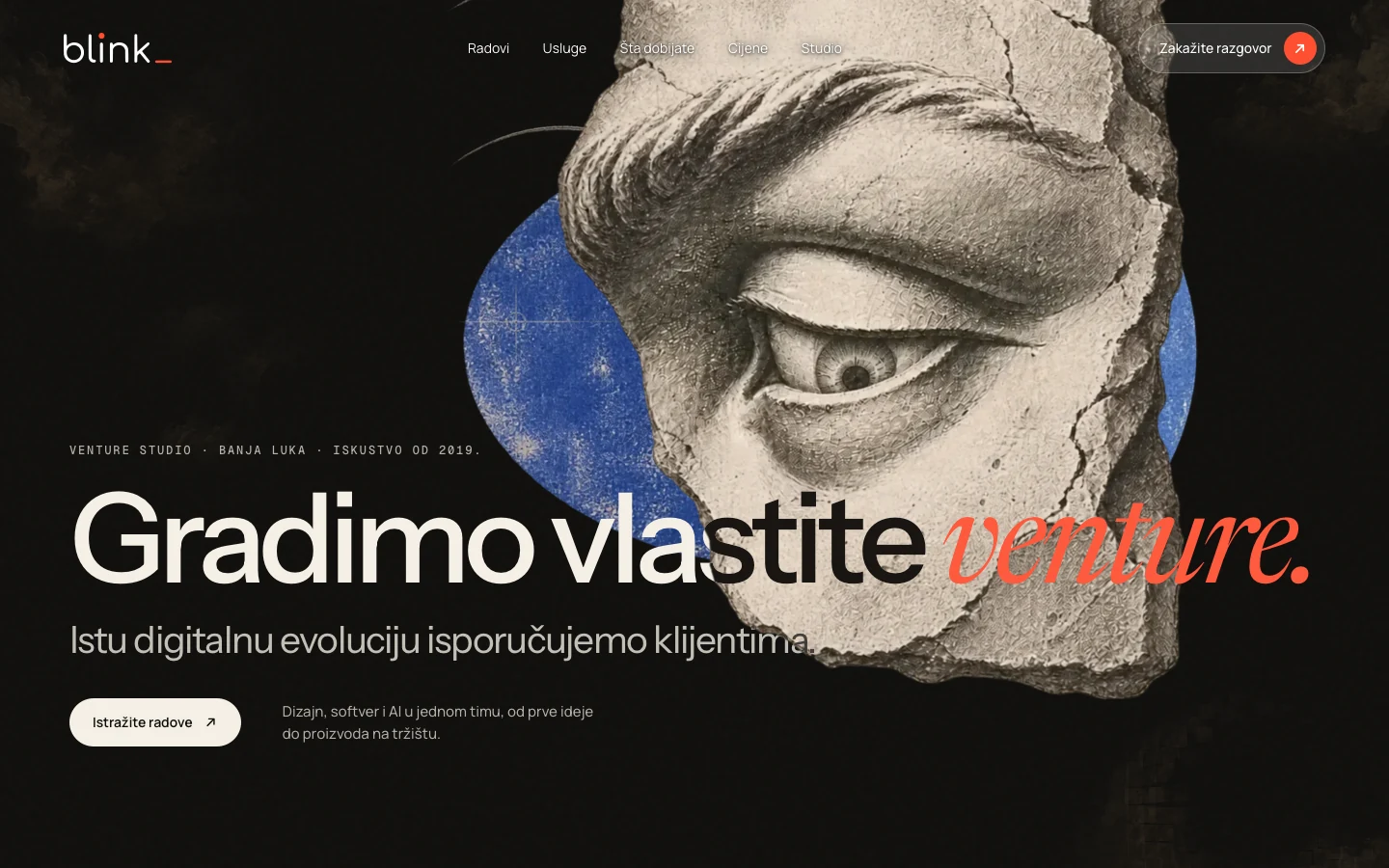
The eye learns before the hand. Every interface begins as a gaze — a fraction of a second where the visitor decides: stay or leave. Beauty is not ornament. It is the shortest path to trust.
Fragments from the screen, the street, and the sketchbook.
Quiet correspondence preferred. For anything urgent — a voice call cuts through faster than a thread.