The problem with looking like everyone else
Open a dozen local business websites one after another and you will find the same structure: a large photograph, a headline, three columns of services, a contact form. There is nothing wrong with that structure. It is clear and it works. The problem is that it is everywhere, so it says nothing about the business behind it.
A visitor who has seen the same layout ten times that day does not remember the eleventh. They may read it, they may even find what they came for, but an hour later the site has blended into all the others. For a brand that wants to be chosen, not just found, that is a real cost.
An immersive website is one answer to that. Not the only one, and not the right one for every business, but a strong one for brands whose value lies in material, space, craft or atmosphere.
Remembered, not just visited
An experience moves with the visitor. On the Longi homepage a single marble slab turns in the light and becomes a kitchen island, a console and a desk as the page scrolls. Nobody needs that explained. They watch it happen, and the material does the talking.
That is the core of the argument: people remember what they experience more readily than what they read. When the scroll itself tells the story — a building opening wing by wing, a kitchen assembling piece by piece — the visitor leaves with an image, not just a list of facts.
Memory matters because most decisions are not made on the first visit. A client compares, leaves, comes back. The site that stayed in their mind is the one they return to.
The site says what the price says
Watchmakers, carmakers and fashion houses present their products as experiences for a reason. The presentation itself communicates value before a single specification is read. A careful, unhurried page with light, motion and detail tells the visitor that the product received the same care.
The same applies closer to home. A furniture atelier, a residential development, a hotel, a stone supplier or a lighting studio all sell something whose value is partly felt. For them the website is the first room a client walks into. If that room looks like every other room, the product inside it has to work harder.
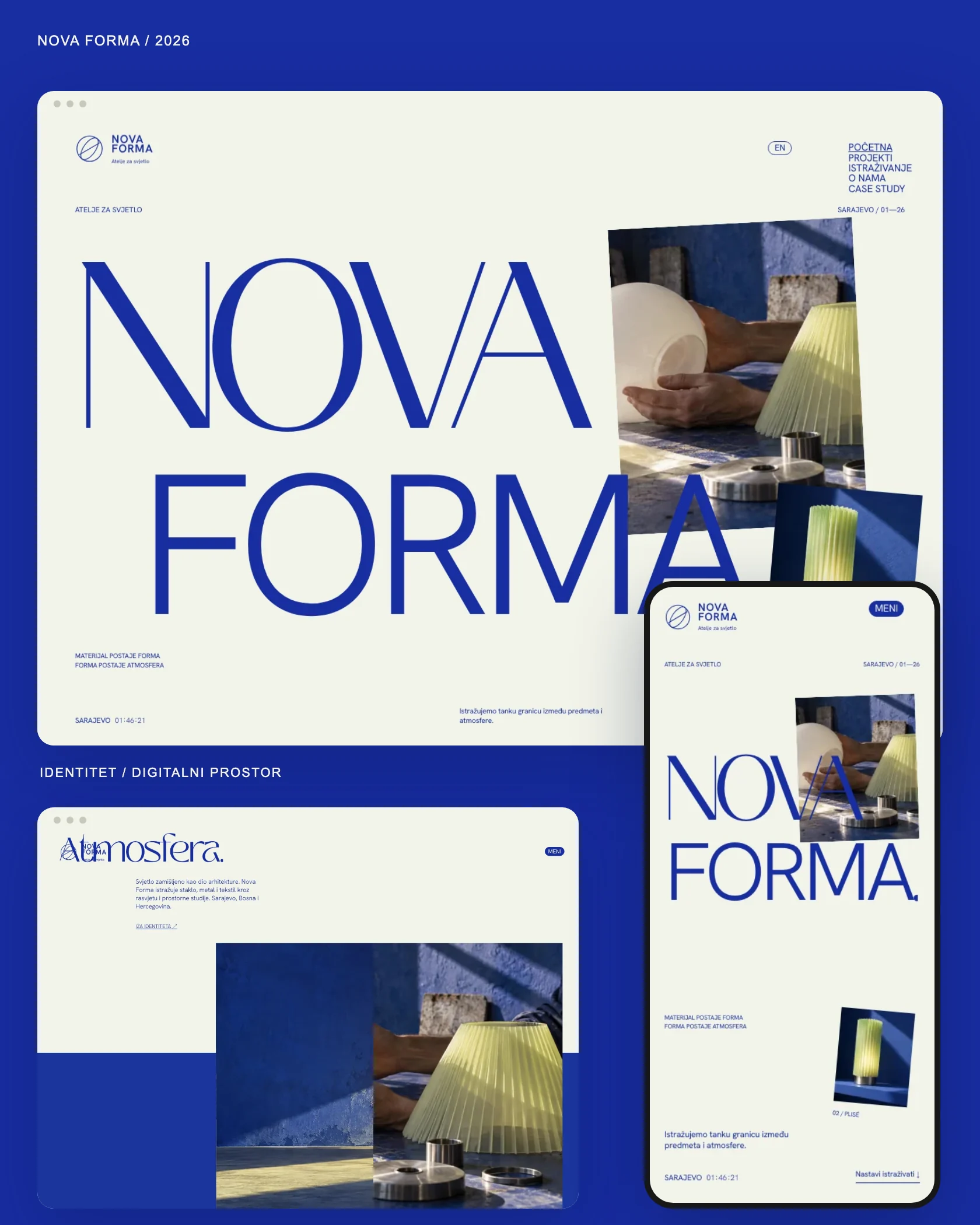
Nova Forma, a self-initiated concept I made for an imagined lighting atelier, explores exactly this: a cobalt visual language that connects the objects and the transitions between pages, so the whole site feels like one composed space rather than a catalogue.
A product that explains itself
Some things are genuinely hard to judge from a photograph. The grain of a stone slab. How an apartment sits in a building and where the light falls. How a kitchen front looks in another finish. In these cases 3D is not decoration — it is the clearest way to show the thing.
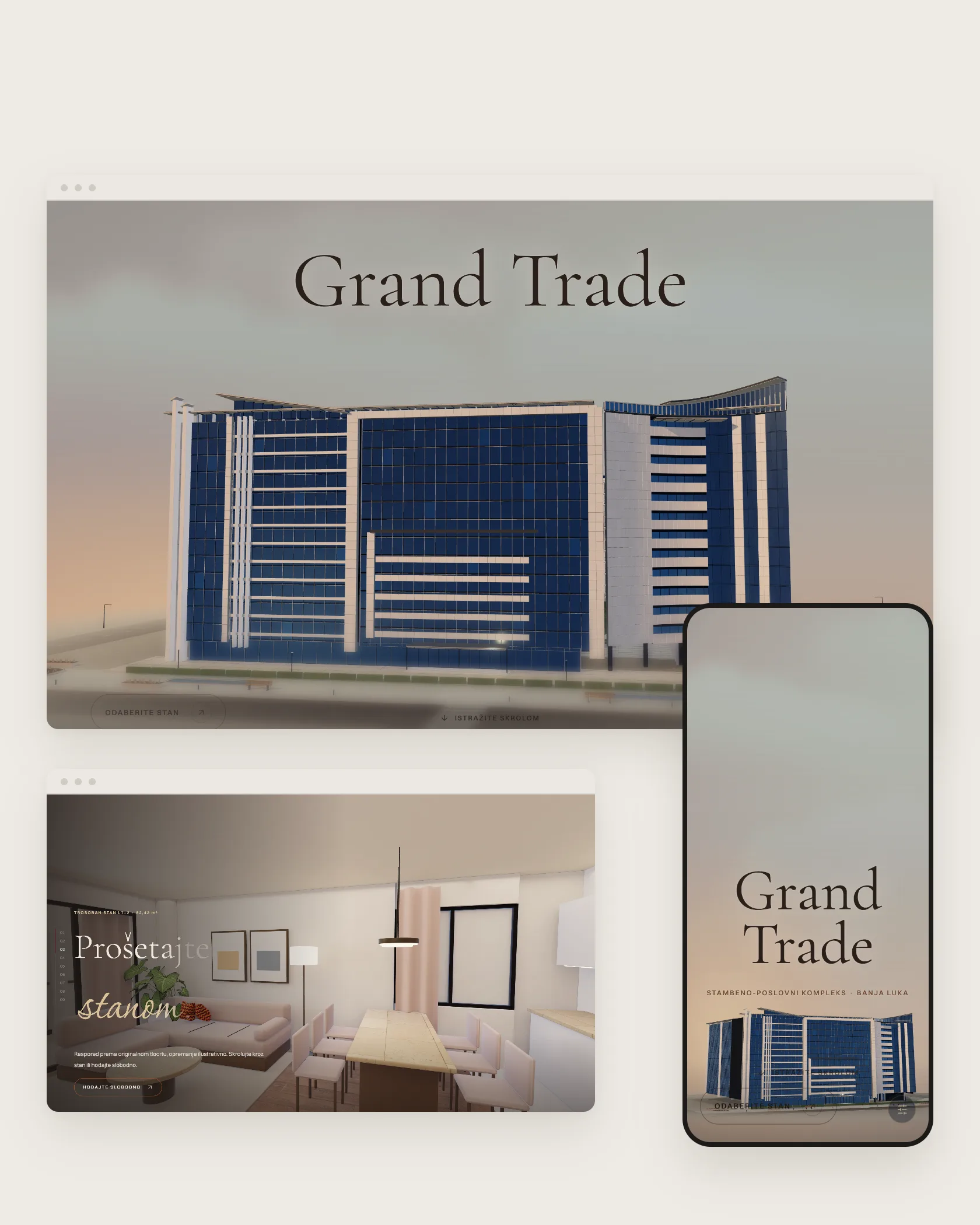
Grand Trade, a project preview for a residential development in central Banja Luka, introduces the building wing by wing, connects the apartment selection to its floor plan and offers a walk through an apartment. A buyer moves from the whole building to one specific home instead of scrolling a table of numbers.
On Longi, also a project preview, the material leads and the commerce follows: after the 3D opening the experience continues into a catalogue with prices in KM, a basket and checkout. The spectacle exists to bring the visitor to a decision, not to replace it.
Reach you do not pay for
Well-made interactive websites get shared. People send them to friends and colleagues, designers write about them, and international galleries of web design collect and feature them. That attention comes from the work itself, not from an advertising budget.
For a local brand this kind of earned reach is unusual. A campaign stops when the money stops; a website people talk about keeps working. It also attracts a particular kind of attention: other businesses who want the same, partners, press and talent.
None of this is guaranteed, and I would never promise it. But an ordinary template site has almost no chance of it, while a distinctive experience at least gives the brand something worth sharing.
Why this is an opportunity here
In our region, websites like this are still rare, and few people know they can be designed and built locally. Most assume this work comes only from large international studios, or do not think of it as an option at all.
That is exactly the opportunity. In a market where everyone uses similar templates, the first brand in its field to present itself properly sets the standard the others are compared to. Being first matters more than being loudest.
I live and work in Banja Luka, and the studio work runs through Studio Blink. The same tools used by international studios — Three.js and WebGL for 3D, shaders for texture and light, GSAP and smooth scrolling for motion — are what I use every day. Distance is no longer the barrier it once was.
How to brief a project like this
You do not need to know the technology to start. What helps most is clarity about three things: what you want people to feel, what you want them to understand, and what you want them to do next — call, book, buy, ask for an offer.
Bring references you admire, even from unrelated fields. A fashion site, a car configurator, a museum page — anything that made you stop. References say more than adjectives like “premium” or “modern”, which mean something different to everyone.
And bring the material: the product, the space, the photographs, the samples, the floor plans. A good experience is built from something real. The more I understand the object, the better the scene that presents it.
What it asks of you
An immersive site asks for more involvement than a template. There are decisions about story and pacing, about which moment deserves motion and which should stay still. I will propose them, but they work best when the client takes part.
It also asks for good source material. A 3D scene of a product needs accurate references; a building presentation needs plans and finishes; a material needs proper texture photography. Where material is missing, it can be created, but that is part of the work and part of the conversation.
Finally, it asks for patience with iteration. Motion is felt, not described, so we look at it together in the browser, on your phone, and adjust until it feels right.
When it is the wrong choice
If visitors need one piece of information fast — opening hours, a phone number, a booking form — effects only get in the way. A pharmacy, a taxi service or an emergency repair business is better served by a fast, clear site than by an experience.
An experience must also respect everyone who visits. This website measures the device and gives weaker phones a lighter version, keeps the essential information readable without any of the effects, and honours the system setting for people who prefer less motion.
If it slows the page, hides what a buyer came for or breaks on an ordinary phone, it is not an experience — it is an obstacle. Done properly, it is both impressive and fast. That balance is the actual craft.