One question before anything else
Every 3D scene on a website should answer one question: what decision does this help the visitor make? Which apartment. Which finish. How many packs. Whether this material is right for the room.
If the scene has a clear answer to that question, it earns its place. If the honest answer is “it looks impressive”, it is probably decoration — and decoration that costs loading time, battery and attention.
This is not an argument against spectacle. It is an argument for spectacle with a purpose. The best 3D on the web feels effortless precisely because it serves something the visitor already wanted to know.
When it helps
3D helps when the thing being sold is spatial or material and hard to judge from photographs. An apartment in a building that is not finished yet. A kitchen front in a particular finish. A stone slab whose grain matters. A floor whose pattern changes the whole room.
In these cases photographs either do not exist yet or cannot show what matters. A scene the visitor can move through, turn or change gives them what a photograph cannot: their own point of view.
It also helps when the product is a system rather than a single object — a building made of wings, a kitchen made of modules, a catalogue of finishes that combine. 3D can show how the parts fit together.
Real estate: from building to apartment
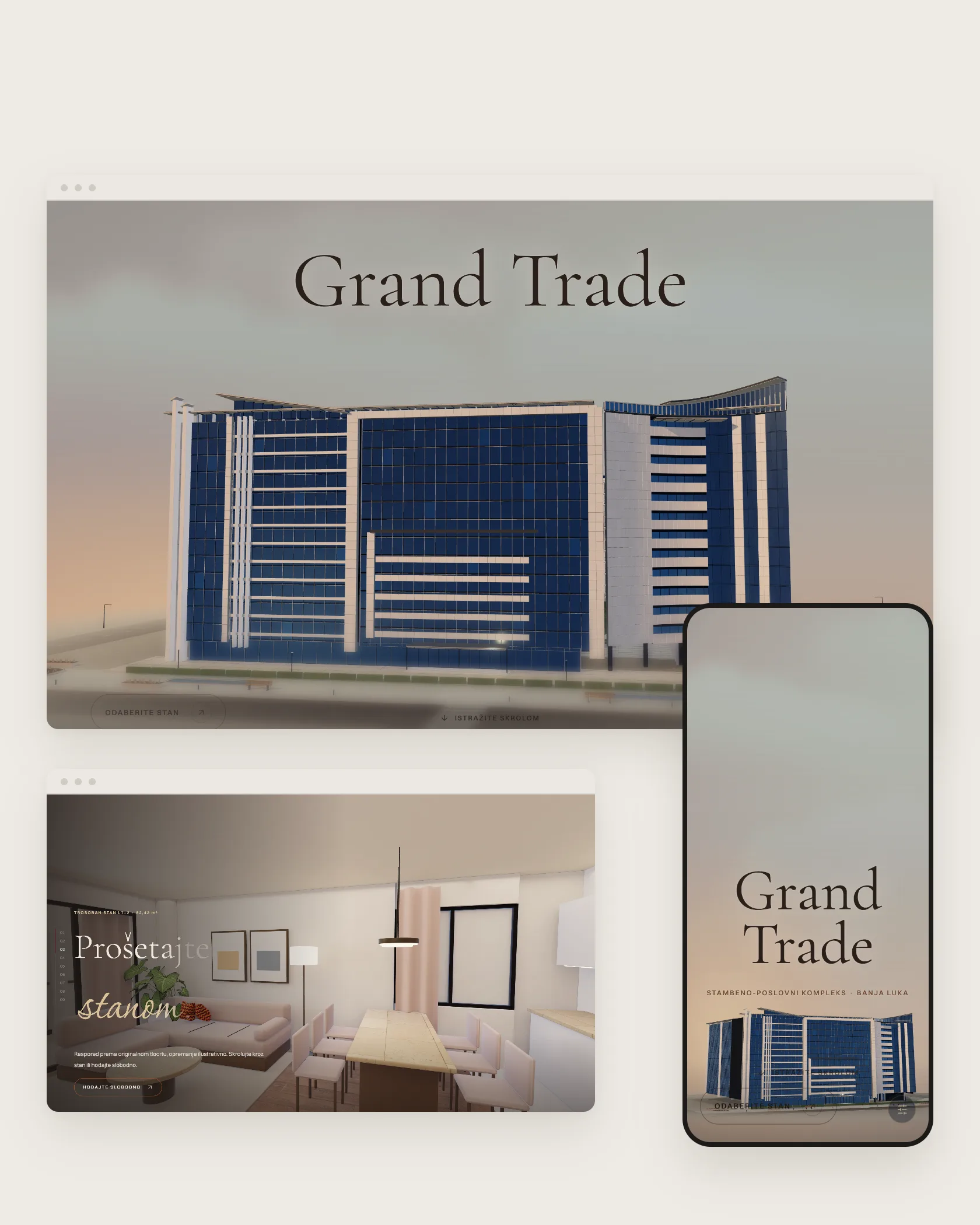
Grand Trade, a project preview for a residential development in central Banja Luka, presents the building wing by wing. The apartment selection is connected to its floor plan, and the experience offers a walk through an apartment.
The point is the path. Instead of opening a table of numbers and square metres, a buyer moves from the whole building to one wing, one floor, one specific home. Each step narrows the choice, and the 3D is what makes the step understandable.
For a development that is still being built, this is often the closest a buyer can get to the real thing before the first visit.
Kitchens and boards: from finish to order
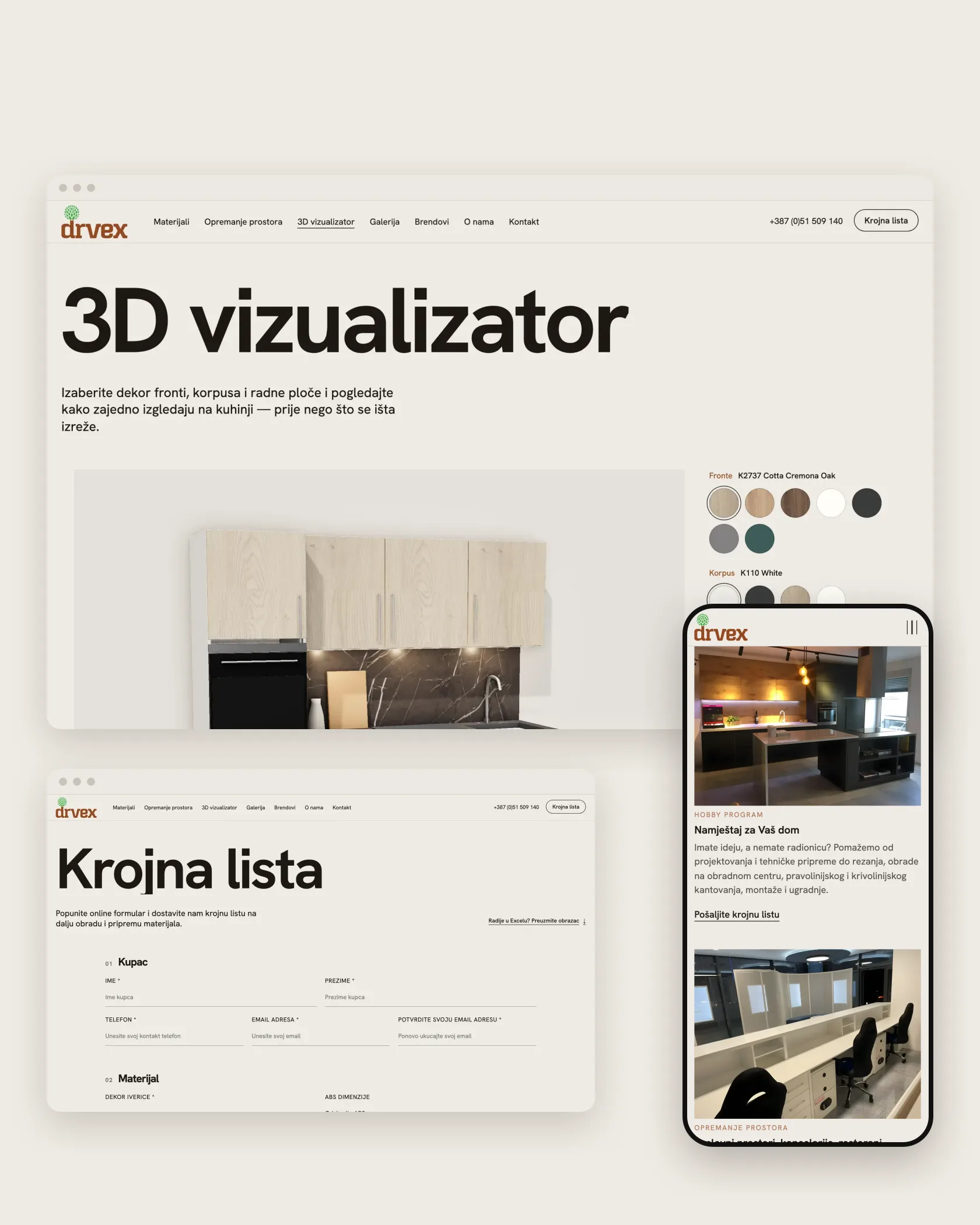
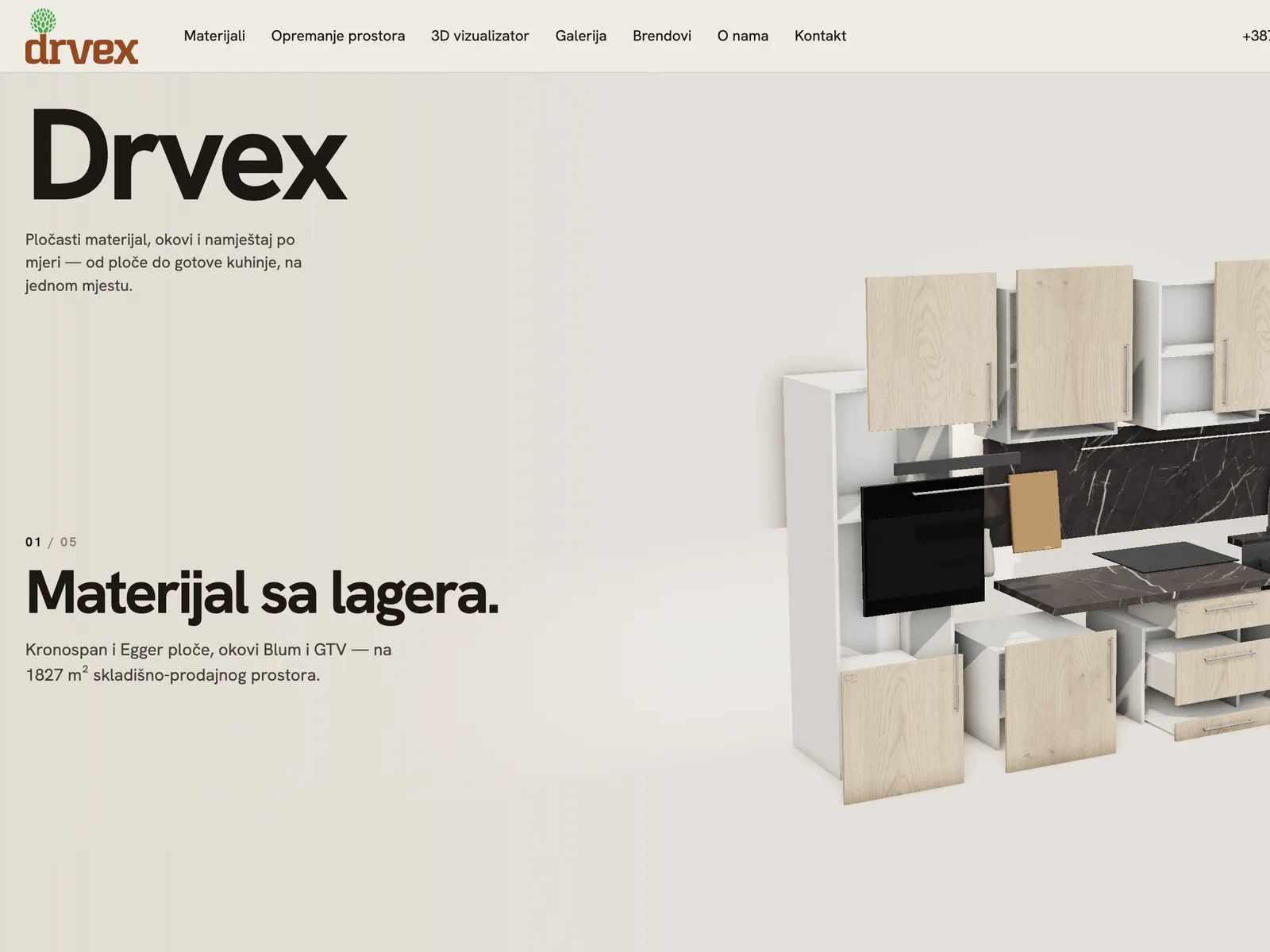
Drvex, from Trn near Laktaši, has sold board materials and fittings since 1991. In the project preview of their new website, a kitchen assembles on the homepage as you scroll, and a material visualiser shows kitchen fronts in the finishes they actually stock.
The scene does not end with admiration. It continues into an online cutting list that arrives already calculated. The customer goes from “what would this look like” to something they can order.
That continuity is the difference between 3D as an attraction and 3D as a tool. The visualiser exists because choosing a finish from a small sample is hard, and the cutting list exists because the choice should lead somewhere.
Material as the lead
On the Longi homepage — also a project preview — one marble slab becomes a kitchen island, a console and a desk while the page moves. The material is presented first, the product types second, and only then the catalogue with prices in KM, the basket and checkout.
Here 3D carries the brand’s idea: that the material comes first and furniture is what it becomes. A photograph of each piece would show the furniture; the scene shows the thinking behind it.
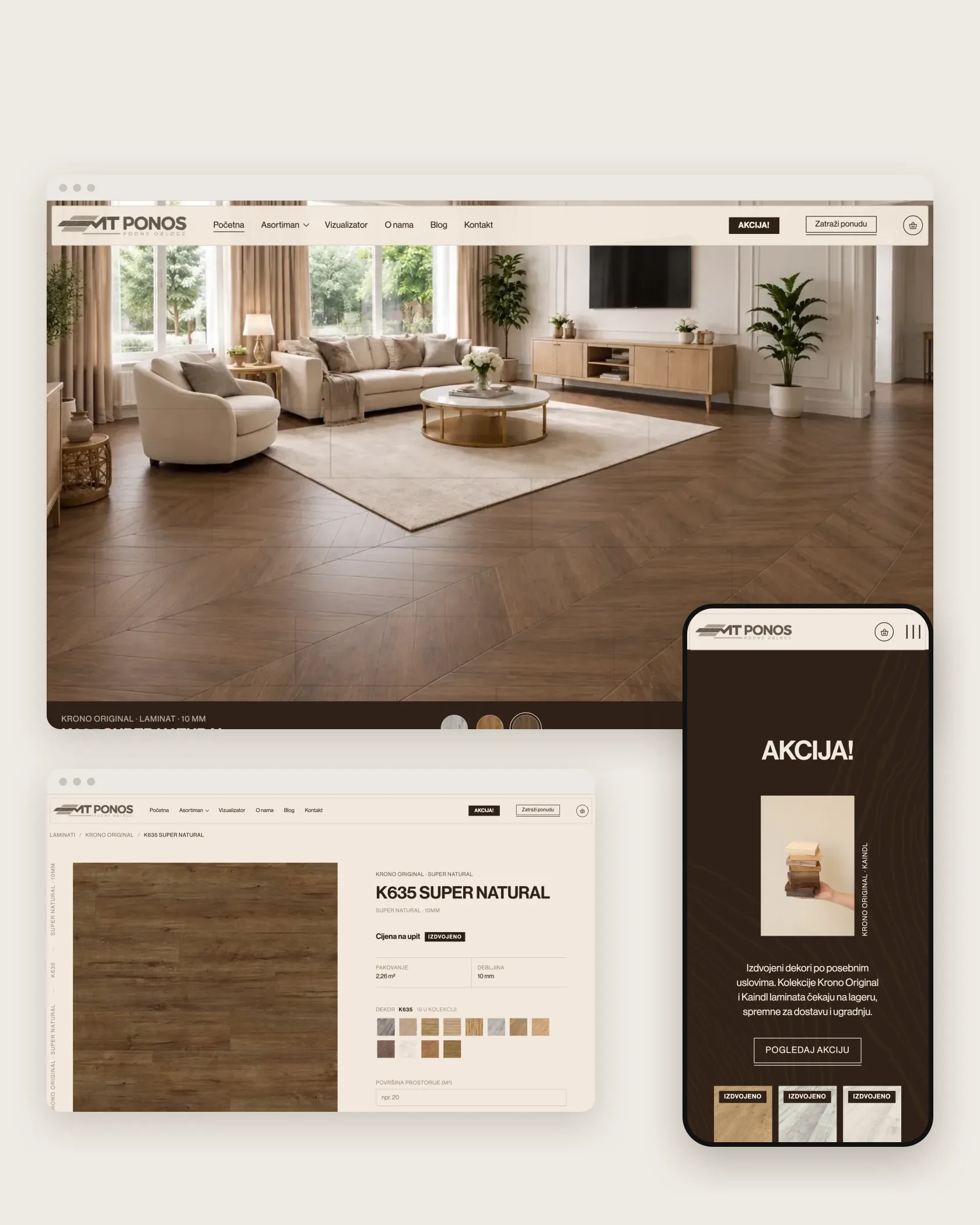
In a proposal for MT Ponos, a flooring retailer from Banja Luka, the same logic takes a practical form: a catalogue with room previews and a calculator that turns room measurements into packs and carries that calculation into the enquiry. This is a redesign proposal, not a launched site.
When it hurts
3D hurts when it delays the information a buyer came for — price, size, availability, a phone number. A heavy scene placed in front of basic information is a wall, not a welcome.
It hurts when it makes the page slow or unstable on an ordinary phone. Many visitors are not on a powerful computer, and a scene that runs beautifully on a designer’s laptop can stutter or fail elsewhere.
And it hurts when it exists only because a competitor has it. Copying an effect without the reason behind it usually produces the effect without the benefit.
Questions worth asking first
Will the visitor understand the product better after the scene than before it? If a clear photograph and two sentences would do the same, the scene is not needed.
Does the scene lead to an action? A floor plan, an enquiry, a cutting list, a basket. 3D that ends in nothing leaves the visitor impressed but no closer to deciding.
Is the source material accurate enough? In real estate the plan, the orientation and the finishes must match what is being sold. In materials the texture and colour must be honest, because a buyer will compare the screen with the real sample.
Who will keep it up to date? Finishes change, apartments are sold, products are discontinued. A scene connected to real data — the catalogue, the list of available apartments — stays useful longer than one that has to be rebuilt by hand every time something changes.
How to do it properly
Keep the key information readable without the 3D. Price, contact, the essential description — all of it should be available even if the scene never loads.
Load scenes progressively and only when they are needed. Give weaker devices a lighter version instead of a broken one. This website does the same: it measures the device and lowers the effects instead of failing, and it respects the system setting for people who prefer less motion.
Finally, test on real phones, not just on a fast desktop. The experience a buyer has on an average phone on a mobile connection is the one that decides whether the 3D was worth it.
Where to start
Start with the decision, not the effect. Write down the choice your customers struggle with most — the apartment, the finish, the quantity — and what information they need to make it.
Then gather what exists: floor plans, material samples, photographs, product data. A good scene is built from accurate material, and in real estate and materials accuracy is part of the trust.
From there we can decide together whether 3D is the right tool, which moments deserve it and which should stay simple. Sometimes the honest answer is that a calculator or a clear gallery does the job better, and that is a good answer too.